
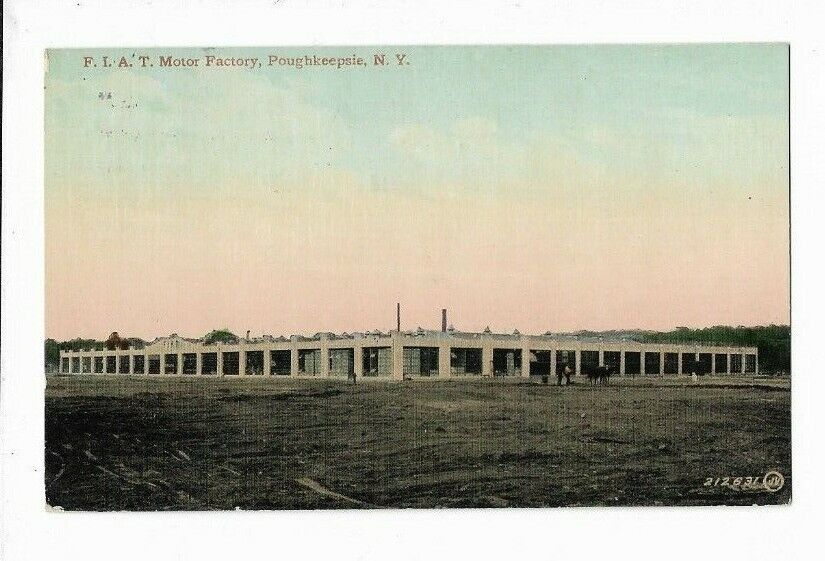
 In 1909, a Fiat auto plant was established in northern Poughkeepsie, NY, reflecting the pioneering spirit of a wealthy diamond merchant. He envisioned selling cars to affluent Americans—a concept ahead of its time. Located across from Marist College and bordered by Route 9 and Fulton Street, the factory specialized in large cars designed to compete with luxury brands such as Peerless and Pierce-Arrow. The vehicles cost between $4,000 and $6,100, equivalent to approximately $101,900 to $155,340 in today’s dollars after adjusting for inflation.
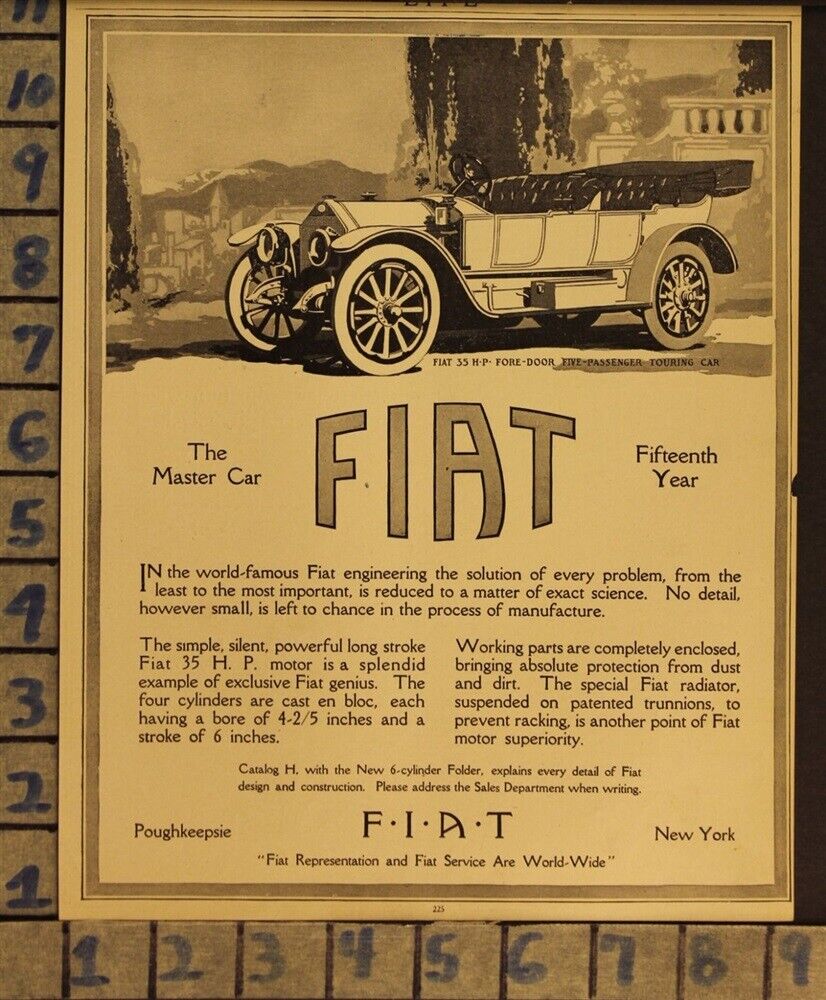
Click to enlarge.
Despite the common belief, this venture was a private initiative and did not require financial support from Fiat of Italy. The American company paid a royalty to Fiat in Turin, Italy, for each chassis and held rights to all of the Italian designer’s patents.
While Fiat in Turin, Italy, produced both small, fast cars and larger touring cars, the American company focused more on large touring cars, such as the mammoth Type 56, a 45 HP, 6-cylinder, 7-passenger Limousine with a four-speed manual transmission. This car, a true engineering marvel, weighed about 5,000 pounds, had no front brakes, and cost about $5,000. Surprisingly, 45 HP could move a 5,000-pound car!
In 1912, the plant produced over 300 vehicles annually. Production peaked in 1914 with four different models, but by 1918, the venture had essentially ended.
In 1917, Fiat in Italy took over the American Poughkeepsie Fiat Plant, and the Type 55 became the only offering until production ceased by the end of the year, owing to the devastating impact of World War I. The plant was manufacturing munitions for the war effort at that time. Many attribute the venture’s demise to WWI and the lack of a competitively priced vehicle. In 1935, Western Publishing took over the site until 1983, after which it was used by Marist College, Staples, a Job Lot, and a Home Depot.
Explore the Hudson Valley
Discover restaurants, farms, shops, crafts and makers, and more throughout the Hudson Valley.
Find Destinations →